Recent reports from The New York Times and other sources have confirmed that a six-day Immigration and Customs Enforcement (ICE) operation in Florida led to the arrest of more than 1,100 individuals. ICE has stated this was one of the largest enforcement actions conducted in a single state in the agency’s history.
This operation was part of the 287(g) program, which enables ICE to collaborate with local law enforcement agencies on immigration matters. While the program itself is not new, its implementation has shifted. Previously, local authorities Primarily assisted ICE with individuals already detained in local facilities. Now, ICE is authorizing these agencies to carry out immigration arrests directly in the community.
During the recent operation, ICE partnered not only with the Florida Department of Corrections but also with the Florida Fish and Wildlife Conservation Commission. Employees from both agencies have minimal—if any—training in immigration law. This lack of expertise increases the risk of wrongful arrests, including the detention of U.S. citizens or individuals with protected immigration status.
ICE claimed that the operation focused on individuals with criminal histories or outstanding deportation orders. According to ICE, over 60% of those arrested had either an arrest record or a conviction—terms that include people who were arrested but not convicted. This statistic implies that a significant number of those taken into custody had neither deportation orders nor criminal records.
Alarmingly, many of those arrested were parents of U.S. citizen children. In response, some schools are now developing policies to support students whose parents have been detained. These include protocols for handling situations when children dropped off at school and the parents were arrested while the children are at school. The schools are also developing strategies for reacting if ICE agents appear at a school.
To support families at risk, the American Immigration Lawyers Association (AILA) has created a Guide for Undocumented Parents with Children. This guide provides essential advice on creating a Family Safety Plan, helping children understand what to do and whom to contact if their parents are detained. It encourages families to gather critical documents—including birth certificates, passports, Social Security cards, and proof of legal status where applicable. Parents are also advised to collect school and medical records.
The guide recommends storing original documents in a safe place, sharing copies with trusted caregivers, and keeping electronic backups. In addition, it includes legal and financial planning tips to help families prepare for unexpected separations.
You can access the AILA guide here.
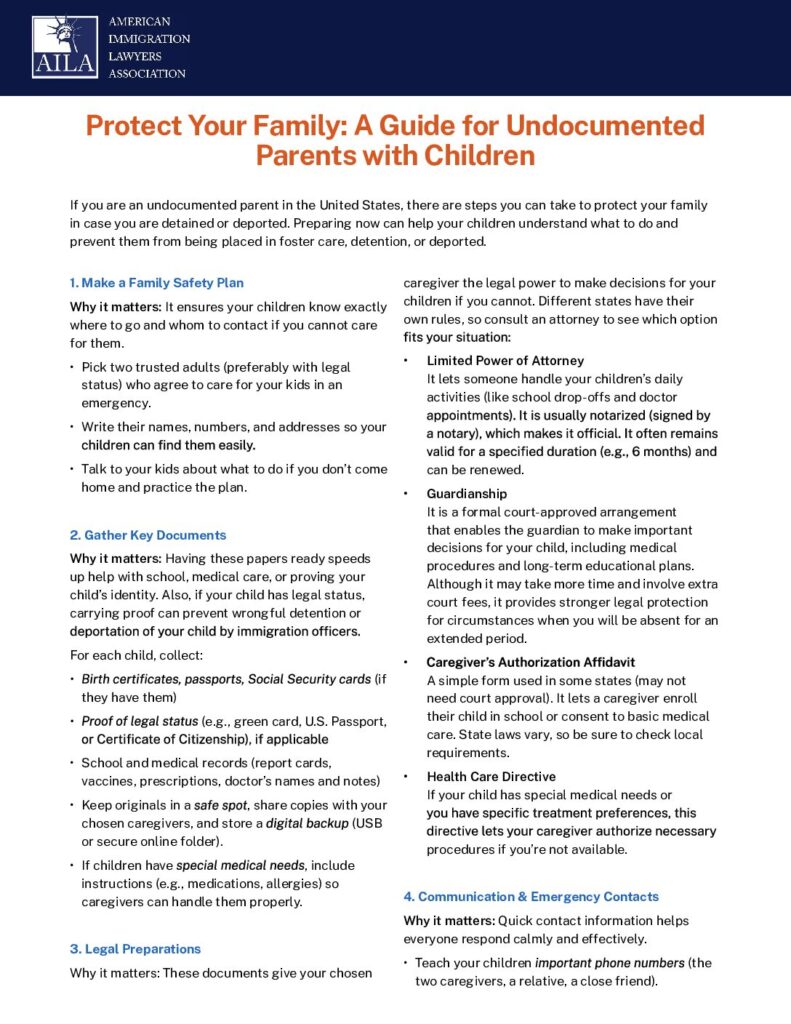

- Protect Your Family: A Guide for Undocumented Parents with Children - May 5, 2025
- To Travel or Not to Travel? - March 24, 2025
- Birthright Citizenship – what is it and is this right in danger ? - February 10, 2025